
In America, Sukkot is a backyard holiday. I once saw a sukkah in someone’s front yard, and it scarred me. That awkward, small, square structure with burlap walls and branches on the roof, right there by the sidewalk on Acton Street in Berkeley, looked as vulnerable and inappropriate as someone arriving at school without shoes.
It’s one thing to be serious enough about religious practice to build a hut and live in it for one week a year. But very few American Jews would build a sukkah in their front yard. Who wants every Madison, Oliver and Lucas on their way home from school, stopping to scratch their heads and wonder, “Why is there a little house in their front yard? That is so, so….weird…”
And what if I was outside when those children happened by, and they asked me to answer their question? What would I say? That G-d instructed me, commanded me, to build this booth, right here in Berkeley, California, because I am a direct descendant of the Biblical Israelites and this is now my desert?
No way I am having that conversation.
The sukkah embodies exilic ambivalence: we build our sukkahs. We build them with joy. But in the backyard, thank you for much, tucked well away from strangers’ quizzical gaze. So whether the 98.4% of Americans who are not Jewish fear, admire, respect, or abhor me and my strange booth doesn’t give me much concern.
****
In Israel, Sukkot is first and foremost a national holiday. Both religious and secular schools are closed. Just weeks after the national sigh of relief that school has finally resumed, the country goes back on vacation. The last two weeks of August magically transport themselves to early October.
In all other years at this time, the country explodes. People crowd onto beaches and pack into museums. Festivals pop up all around the country. Dance festivals, Theater festivals. Music festivals. Film Festivals. Hot Air Balloon Festivals. Open air street festivals. If you can imagine an activity that involves people getting together, it is likely happening in Israel on Sukkot. The last heat waves of summer break have finally departed and the winter rains have not yet arrived. The air is balmy but not hot, the skies are blue and clear, and everyone is looking for something to do.
But this year is not like all other years.
The seger (lockdown) has mandated that no one can leave a 1km radius of their home, save for groceries, medicine, and a long list of other activities that reads somewhat comically to this immigrant eye. There is a lengthy section on exactly how to organize religious services by breaking a large group into smaller capsulot. It describes in detail who can stand where, and how many in the big group and how many in the small group, for how long and at what distance from each other. But will promulgating such regulations really lead everyone to observe them? I am doubtful.
****
My mother brings news that there is a music concert a few streets over. “Bring chairs,” she instructs.
A street concert? How is that possible? I’m quite sure that concerts are not allowed during lockdown. But my sister insists that it is a concert, and the musicians have worked it out with the city to get a permit for a concert.
“No way I’m going to a concert,” my son says. “That is definitely not Corona-safe.”
We hastily finish our dinner in the sukkah, worried that we’ll be late. “It’s Israel,” my sister laughs. “Finish your dinner. Nothing starts on time.”
Half an hour later, after my kids and parents and sister have already made their way to the concert, I follow. I’m only a few days out of quarantine from my own Covid-19, and my energy level is still like that of a person twice my age.
I arrive at the corner my mother said to come to. I hear music. I see a speaker on a stand across the street, and another one fifty feet away in either direction. I hear the concert, but I can’t see or even figure out where the band is. Also, where is the crowd?
My brain feels like eyes adjusting to a sudden change in light. I just can’t figure out what this is. My daughter comes running up and gives me a hug, her head tight against my waist. “The band is down there!!! The band is down there!! Let’s go see them!!”
As we walk in the cool evening darkness, I begin to understand. This is a Corona block concert. Instead of bringing all the listeners together, they’ve invited residents of each house to bring lawn chairs to the top of their individual driveways. Inhabitants sit in chairs in a horizontal line, like coffee drinkers people watching at a Parisian cafe. Instead of people watching, however, they are listening to the music, following along on the lyric sheet passed out to each house, occasionally getting up to sing and dance.
As I walk, I realize this concern goes on for blocks and blocks and blocks, each block with speakers of its own to amplify the music. After a few hundred feet, we come to the performers, who have strung some lights in front of them to signify an imaginary sidewalk stage.
“Look Mom, it’s our neighbors!!”
And sure enough, it turns out the band is the family next door, who we have been gathering with every morning in the sukkah for a musical hallel service. I smile and wave. Watching our neighbors perform, I even begin to dance….until the policeman comes and reminds me no gathering. I disperse, smiling.
***
So what happens when there is a week of vacation and nothing, nothing, nothing to do? And worse yet, your Mom is recovering from Covid and has turned into a slug?
T, age 7, has discovered that she can walk to the makolet (corner market) not only with her 8 year old cousin, but even by herself.
A few days ago she offhandedly asked if I could give her my credit card, and not realizing the genie I was about to release, I acquiesced. Since then, she has walked herself to the makolet dozens of times, each time flaunting my Visa like a badge of pre-pre-adolescent freedom.
The first trip she buys herself an Aloe Vera drink. The second trip she buys herself a popsicle. The fourth trip she buys a kitkat for her and a chocolate bar for her brother. The fifth trip she buys bright pink slime. The sixth trip, she decides on bourekas and rugelach from the bakery next store. She has an endless supply of ideas of things to purchase, one item at a time. I am still tired from Covid, and I don’t protest. At least she is exploring.
*****
My nephew B has returned from Yeshiva, and is using his time to study Torah with friends and visit sick and old people in need. “So who did you meet today?” I ask.
He tells us about meeting a former army general who had been part of the Entebbe raid, the man who caught Yoni Netanyahu in his arms when he was killed in the line of duty. This man, this former hero, is now in his late 80’s, confined to bed with lung cancer and a herniated disc. He lives in a cramped, filthy apartment no bigger than a Sukkah. His wife is gone, his two children live in America. He subsists on peanuts and frozen meals. He can’t move, so he relieves himself into cups that line the floor by his bed, creating a stench. His toenails are as long as pencil stubs, and as hard.
“ So how were his spirits?” I ask.
B thinks about the question. “He said to me, ‘I’ve seen death 20 times,’ and showed me the scars and wounds that decorate his shriveled body.”
And then he said, “I’m still here. I’m happy to be alive.”
*****
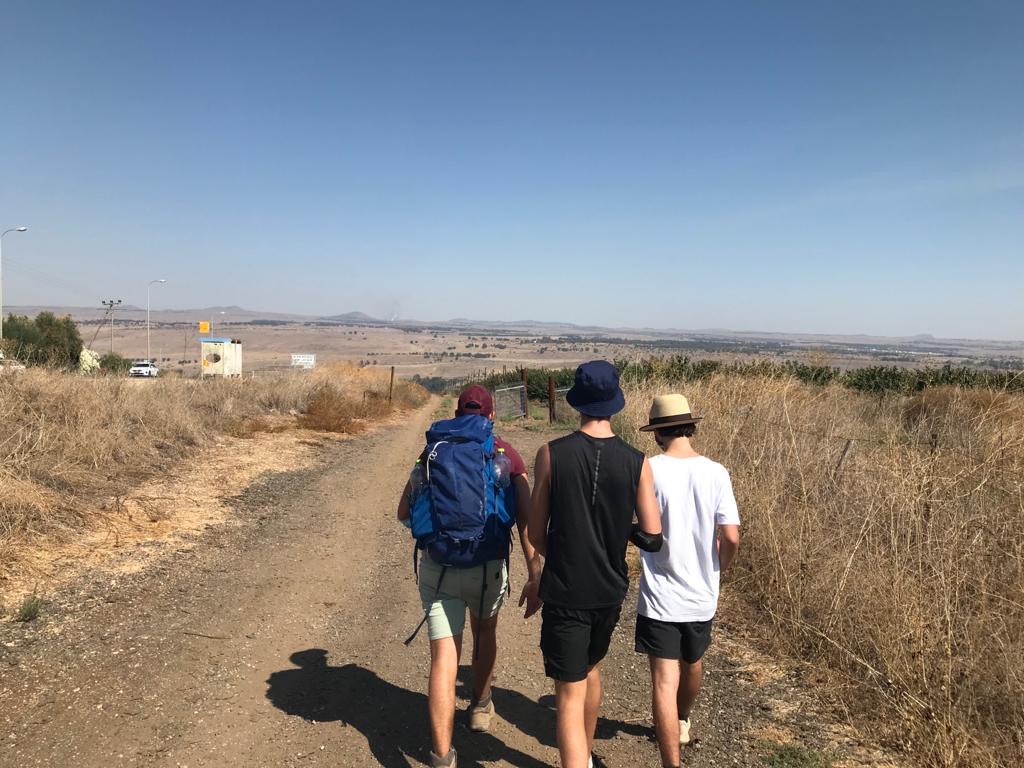
I and his cousin H, who are both 16, learn that a farmer up North is looking for someone to watch his olive groves for a few days while he goes away. My son, nephew, and two friends volunteer to sleep in his field and ward of marauders. They won’t have weapons. They’ll bring their own food and sleeping bags. They’ll sleep under the stars.
My sister puts them on the train heading North and they find their way to the field. While we don’t hear from them for a few days, we aren’t worried.
A few days later, they return. They have sunburned skin, smiles playing at the corner of their lips, and stories to share. Apparently they took a long hike with not enough food and water. They were parched. Just when they were giving up hope of reaching anything, save more fields, they hit the Jordan River. It was like finding an oasis. Ecstatic, they even got to swim.
Upon their return to their field, they saw a man in the distance picking olives by his truck.
“Come help me!” He said, waving a friendly hand. The group circled up into a huddle. “Friend or foe? How could they know?” One of them thought to call Motti, the farmer, and explain the situation.
“Put me on Facetime and bring me to this man!” He ordered.
The boys did as requested. While they walked, they wondered if Motti had thought about the fact that should this man be carrying a weapon, he would be aiming it not at Facetime but at them.
“What are you doing?” He screamed through the phone. “You are stealing my olives! Give me 200 shekels now or I will call the police!”
The man stuck his hands in his pockets and pulled out a fifty from one pocket, and a fifty from the other.
“Not 100 shekels, 200 shekels!”
“I don’t have 200 shekels,” he said calmly.
“Then I am calling the police! They are coming for you now!” And with that, he clicked the phone to take a screenshot of the man’s face.
Despite his calm demeanor, the man suddenly realized that Motti had more power than he had anticipated, and his affect shifted. He tried to wrestle the phone from my nephew’s hand. Failing, he bolted back to his car and drove away.
For four 16 year olds, it was heaven.
*****
There are sukkot everywhere. In driveways, in front yards, house after house, yard after yard. Not everyone has one, but many do. Some apartment buildings have two, three, even four sukkot built in parking spaces, and sometimes on the grass out front. Other apartment buildings have been architecturally designed with “Sukkot balconies” where every apartment has a balcony with a vertical view of the sky.
They are everywhere, these little booths.
And no one worries what the neighbors will think if you build your sukkah in the front yard.
 Pomegranate Dreams
Love this! I was also amazed by the sukkot sprouting off of parking spaces and impossibly small balconies all over Jerusalem. We lived in an old apartment building in Rassco and a couple of families built a sukkah on the bare hillside behind it, right under our bedroom window. They came by to tell us we were welcome to use it, and I remember waking one morning to the sound of small children singing hallel in the sukkah. Only in Israel!
I remember one sukkah in particular, on Tchernichovsky St. The balcony had an overhang so the owners of the apartment had built an awkward extension to the balcony that jutted outward from the building and looked precarious. We decided that was a sukkah we definitely would not want to sit in!
For chol hamoed, we drove north and stayed with Tali and Yaakov and Rachel and Arye in Zichron and there, it seemed like America with most sukkot out of sight.
Chag Sameach! Sara
On Fri, Oct 9, 2020 at 7:25 AM Pomegranate Dreams wrote:
> Sara Bamberger posted: ” In America, Sukkot is a backyard holiday. I once > saw a sukkah in someone’s front yard, and it scarred me. That awkward, > small, square structure with burlap walls and branches on the roof, right > there by the sidewalk on Acton Street in Berkeley,” >
LikeLike
Fascinating! You are such a great writer, Sara!! I hope you get all your strength back soon.
Love,
your aunt Paula
LikeLike